

LEGAL
MARKETING, LLC.
A long letter from Ben Glass to a lawyer who is tired of paying more and more, every year, for less and less
Making Money in the Dark
How today’s solo and small-firm lawyer can build the practice they actually want — without spending a bundle on digital advertising or traditional general media.
Dear Friend,
I want to tell you what happened to me last Tuesday.
You may be sitting in that same parking lot.A lawyer I know — runs a small firm in a city I’d rather not name — called me on his cell phone from his car. He was upset. He had just gotten off a Zoom with his “marketing agency.” The agency told him that to maintain his current intake volume next year, his digital advertising spend was going up another twenty-two percent. On top of the eighteen percent increase from the year before. On top of the fourteen percent from the year before that.
Then they walked him through next year’s “strategy.” Same channels. Same platforms. Same agency. Just more expensive.
When he asked what would happen if he didn’t approve the increase, the answer was the kind of polite blackmail you can probably hear in your own head right now: Well, we can’t promise you’d hold position. The auction is competitive. Your competitors are spending more.
Then, there was more bad news: and that’s if they don’t change their algorithm again!
He sat in his car in his own parking lot for twenty minutes and then he called me.
He said: “Ben, I have been in practice for nineteen years and I am tired. I am tired of paying more every year to make the phone ring. I am tired of running a firm whose growth depends on whether some algorithm at Google likes me this month. I am tired of competing in a game where the only way to win is to spend more than the firm down the street, and the firm down the street is owned by a private-equity-backed roll-up that has more money than I will ever have. What do I do?”
I am writing this letter to you because I think you might be sitting in the same parking lot. Maybe not today. But sometime in the last twelve months, you have had a version of that conversation — with your marketing agency, with your spouse, with yourself at three in the morning. The numbers don’t work the way they used to work. The growth doesn’t compound the way it used to compound. The harder you push the engine, the more it costs to run.
I want to tell you that there is a better way to run a small law firm. I have been running my own that way for over thirty years. I am going to show it to you in this letter. And at the end, I am going to make you an offer that, if you take it, will save you from another year of that parking-lot conversation.
Your risk on this is zero.
I’ll say this now, up front, so you can read the rest of this letter with your guard down: everything I’m about to describe is backed by a full one-year, 100% money-back guarantee. Put it to work for a year. If it doesn’t move your firm, I’ll send back every dollar — and you keep all three books. There is one fair condition. I’ll spell it out near the end of this letter.
But First — Who I Am, in Case You Don’t Know Me Yet
My name is Ben Glass — Dad to 9, married 45 years, soccer referee, CrossFit athlete.
I have been a personal injury and long-term disability lawyer in Fairfax, Virginia since 1983. I founded BenGlassLaw in 1995. As of this writing, our firm has filed more than 150 federal long-term disability and life insurance cases since 1999. We currently manage over $45 million in future disability benefits for clients on claim. We have recovered more than $50 million in benefits for those clients. Last year we secured a Fourth Circuit decision — Cogdell v. Reliance Standard — that resolved a national circuit split on ERISA deadline forfeiture.
The disability practice is half of what we do. The other half is run by my son and partner, Brian Glass, who heads up our personal injury division. Brian and our PI team have handled thousands of cases — auto accidents, wrongful death, brain injuries, motorcycle and pedestrian cases — for clients across Virginia, from Fairfax to Lynchburg to Norfolk, since the firm opened. We have recovered hundreds of millions of dollars in verdicts and settlements over forty years of practice, including the $4.24 million Fairfax County jury verdict Brian secured in 2022 for a client critically injured by a drunk driver — including $1 million in punitive damages, the largest punitive award in a DUI case in Virginia history. We have been voted the #1 Northern Virginia Law Firm by Virginia Living magazine’s Best of Virginia readers in 2023, 2024, and 2025. Like the disability side of the firm, the personal injury practice was built primarily on referral relationships — physicians, chiropractors, prior clients, and other lawyers — not on broadcast advertising or paid digital.
Real growth, in a consumer-facing law practice, comes from the trust other people place in your name when you are not in the room.
I tell you these numbers not to impress you. I tell you them because almost none of that practice was built with paid advertising.
No Google Ads. No billboards. No TV.We do not run Google Ads for either practice area. We have very small Local Services Ad spend. We do not buy billboards. We do not buy television. We have not spent a meaningful dollar on broadcast or paid digital for our work in over a decade. In the ERISA disability space, we dominate the Mid-Atlantic (with clients also spread into just about every state in the country).
How? That is what this letter is about. But before I get into the how, let me tell you a little more about who I am, because the why of this product matters as much as the how.
I have been married to my wife Sandi for forty-five years. We have nine children — four of whom were adopted from China — and seven grandchildren. I played soccer on scholarship at William & Mary, and I have been refereeing the game for more than fifty years — started at sixteen, still on the field most weekends, still able to run with the nineteen-year-olds on the higher-level matches I work. I started doing CrossFit in 2019 because it spoke to the lifelong athlete in me, and at sixty-eight I am still in the gym four or five mornings a week, lifting heavier things than I have any business lifting, because the day I stop doing that is the day a lot of other things in my life start going sideways. In March of 2024 I had triple bypass surgery. I came out of it more committed than ever to the idea that a lawyer’s job is not just to win cases — it is to build a life that the people you love are glad you chose this profession to do it in.
That last sentence is the entire reason GLM exists, and it is the entire reason this product exists. Brian and I did not build Making Money in the Dark so you could become a marketing wizard. We built it so you could spend your Saturday at a soccer field, or in a gym, or at a wedding, or on a couch with a grandchild, or anywhere else that is not in your office solving a problem that better systems would have prevented. The work in this product is in service of that.
I am also the founder of Great Legal Marketing — GLM — the coaching organization I started in 2005 to teach small firm lawyers how to build practices that pay for the lives they actually want. For twenty-one years, GLM has helped solo and small firms across the country build referral and relationship-driven engines that don’t depend on platforms they don’t own. Some of our members you have probably heard of. Most you have not, because the ones who really win at this are indeed the next-door millionaire living the non-flashy, but fun, life.
This letter is about a product I have just finished building with my son Brian and a small handful of the smartest people I know in the legal marketing world. It is, without exaggeration, the most complete teaching of what we actually do at BenGlassLaw — and what some of the best small firms in the country do — that has ever existed in one place.
It is called Making Money in the Dark.
What “Making Money in the Dark” Actually Means
Let me be clear about the phrase, because if you only read the title and walked away, you would walk away with the wrong impression.
Making Money in the Dark does not refer to anything secret, anything shady, anything that would get your license suspended. There is no magic. There is no loophole. There is no money fairy in the legal profession. If there were, she would have shown up at my office by now, and she has not.
What the phrase actually refers to is this: there is a kind of marketing that happens outside the spotlight. It does not appear on Google. It does not appear on Facebook. It does not appear in your local TV market. It does not get scraped by AI tools. It cannot be copied by your competitors because they cannot see it — because they were not on the list, because nothing got posted online.
It is:
- The newsletter mailed monthly to four hundred referral sources.
- The thank-you note hand-addressed to a former client.
- The quarterly partner report sent to twenty physicians.
- The gift box delivered in person to a financial advisor.
- The 144-step internal process documented for the team.
- The Dream 100 list maintained over years.
- The welcome experience engineered for every new client.
- The five-minute response window on every new lead.
- The settle-versary letter mailed every twelve months for the rest of a former client’s life.
None of these things show up in your competitors’ SEMrush reports. None of them get auctioned away by Google when a new firm enters your market. None of them get more expensive every year just because Facebook decided to raise its ad rates. None of them will disappear because some giant tech company decided to change its algorithm on Monday.
They just sit there, in the dark, compounding quietly, year after year, building a referral and relationship pipeline that nobody can take from you because nobody else can see it well enough to copy it.
That is making money in the dark. That is what more than eighty percent of every dollar that flows through my firm comes from. Not paid clicks. Not algorithms. Not bidding wars. People recommending us to other people, year after year, because we engineered the relationships that produce the recommendations.
And the entire premise of the product I am writing to you about is this: a serious 1-to-5 attorney firm, in any consumer-facing practice area, in any town in America, can build the same engine. It will not happen in a weekend. It will start happening in ninety days. And once it is running, it does not cost twenty-two percent more next year just to stay in place.
And your risk stays at zero. The whole set is backed by a full one-year, 100% money-back guarantee. Put it to work for a year. If it doesn’t move your firm, I’ll refund every dollar — and you keep all three books. The one fair condition is spelled out near the end of this letter.
A Word About the Giant Firms Advertising in Your Market
They can’t. Structurally.Before I tell you what is in this product, I want to tell you why the giant firms you see running ads in your market will never, ever do what is in this product.
The giant firms — the ones doing TV, the ones with twelve-figure ad budgets, the ones owned by private equity, the ones whose names are on the sides of every bus in your city — are stuck. They cannot pivot to the kind of marketing I am about to describe to you, because the kind of marketing I am about to describe to you does not scale the way an agency can sell.
An agency cannot sell “build a Dream 100 list of professionals in your local community and contact each one of them by name, with a thoughtful piece of mail, every month, for the next five years.” That is not a contract an agency knows how to write. There is no monthly retainer for it. There is no dashboard for it. There is no algorithm to optimize. Hell, they wouldn’t even know how to write a letter like that.
So the giants do not do it. They cannot do it. They are structurally incapable of doing it, because the entire economic engine of a giant firm depends on marketing that can be bought at scale and managed from a dashboard. The minute the work requires a real human relationship — between you and a doctor, between you and a former client, between you and another lawyer in your town — the giants are out of the game.
That is your opening. That is OUR opening.
This is the only game in modern legal marketing that a small firm can win. Not because the small firm has more money — because it has the structural ability to do the work the giants cannot.
And the lawyers who are quietly building seven- and eight-figure practices in this space — the ones I have been coaching for twenty-one years through GLM — are not lawyers with more money than their competitors. They are lawyers who figured out that money was not the variable that mattered. Their families are thankful for that.
So Why Have I Never Written This Letter to You Before?
Honest answer: because the product did not exist.
For twenty-one years, GLM has taught these principles in conferences, in books, in coaching meetings, in the Renegade Lawyer Podcast. We have given out plenty. We have written extensively about analog marketing — Renegade Lawyer Marketing, Great Legal Marketing, Play Left Fullback, the books I have co-authored with Dan Kennedy. We have brought speakers in to teach specific tactics at our events.
But we have never — never — pulled the whole thing together into a single, complete, sit-down-on-your-desk, work-through-it-in-ninety-days product. We have never opened the actual files at BenGlassLaw and shown a lawyer the real letters, the real reports, the real processes, the real receipts. Until now.
In February of this year, Brian and I hosted what we called the Analog Marketing Bootcamp. We invited the four smartest people we know on the topic of building a small law firm without ad-spend dependence:
- Kia Arian of Zine — two decades helping lawyers build brands that get clients to call rather than shop. She has worked with Dan Kennedy, Kim Walsh Phillips, and Ben Settle, and she is, without overstatement, one of the best brand thinkers in the direct-response world. She has worked closely with Brian and me for nearly twenty years.
- Justin Miller of Jurassic Marketing — runs one of the most respected direct mail operations in the country, mailing millions of pieces a year for law firms across America. His book, Jurassic Marketing, has a foreword by Brian Kurtz, one of the most respected direct-response marketers alive.
- Cassidy Lewis — Chief Marketing Officer at Cooper Hurley Injury Lawyers and founder of The CMO Academy. She runs every digital channel a PI firm runs — and under her leadership Cooper Hurley grew from a few million dollars to over eight figures. Her argument for offline marketing is the argument of someone who has run digital at scale and watched what happens when a firm becomes dependent on platforms it doesn’t own.
- Darin Adams of Thryv — more than a decade teaching small businesses how to use automation and follow-up to stop losing the leads they already have. Before that, a long broadcast-TV career, including a founding role on KSL-TV’s daily lifestyle program — the highest-rated locally produced lifestyle show in the country.
We spent a full day together. Six speakers — Kia, Justin, Cassidy, Darin, Brian, and me. Each one taught the operational reality of how the work is actually done in their own businesses. No slides about “the importance of branding.” No PowerPoint frameworks. Six experienced operators showing a small room of lawyers exactly how they execute a kind of marketing the big firms cannot touch.
And about an hour into the day, Brian and I looked at each other and said: this is the product. This day. Distilled. Compressed. Packaged. Which is what we have spent the past several months building.
What’s in the Box
Three physical books and the entire video and audio archive — each one doing a different job, each designed so the work you do in one shows up in the next.
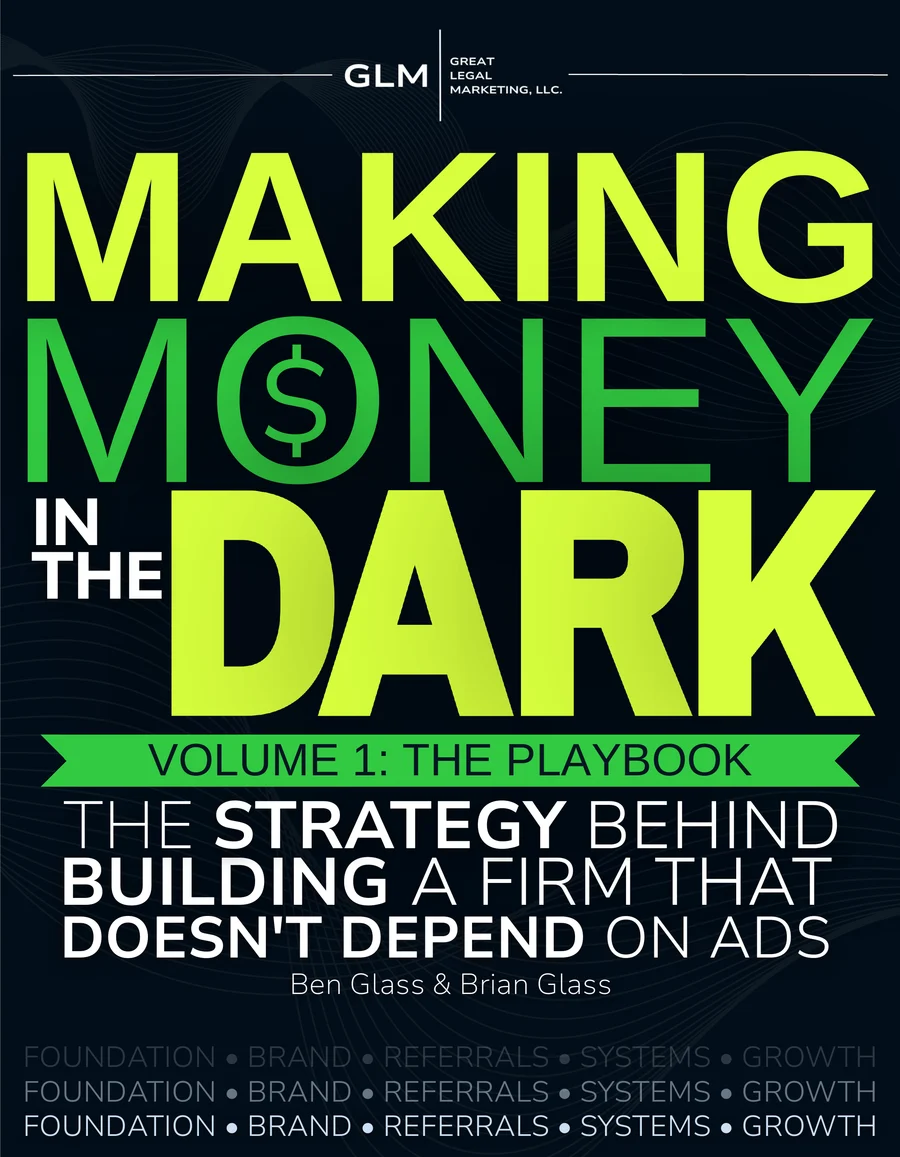
Volume One
The Playbook
The strategy. Roughly 100 pages. Seven chapters drawn from the bootcamp, each one written in book form so you can sit with it and read it the way you would read any serious business book.
- Chapter One — Back to the Future. My own chapter, on the philosophy that has to come before any tactic. The Four Questions you have to answer before you spend another dollar on marketing. The Make Money in the Dark framework. Why analog still wins.
- Chapter Two — Your Brand and Your Highest-Value Client. Kia Arian’s chapter. The single best teaching I have ever read on how a small firm lawyer figures out who they actually serve and how to talk about it. The right-fit client. The outcome statement. The through-line. Kia normally walks clients through this in 15 to 20 hours of one-on-one work; she compressed it here.
- Chapter Three — Marketing to Centers of Influence. Brian’s chapter. The Dream 100 method, adapted from Chet Holmes. The intake-script reframe — who can we thank for the referral? — that changes what you know about your own business. The chiropractor case study behind the firm’s 27-day-from-treatment-to-demand timeline. On its own, this chapter will pay for the entire product if you take it seriously.
- Chapter Four — Direct Mail and the Jurassic Trifecta. Justin Miller’s chapter. The three asset types — newsletters, referral letters, end-user mailings — that, run consistently, can carry an entire small firm’s offline marketing. The operational math, the cadence, the list-building, the 40-40-20 rule, and why direct mail is less crowded than at any time in forty years.
- Chapter Five — Anything But Digital. Cassidy Lewis’ chapter. The three-pillar framework — clients, colleagues. The welcome experience. The anxiety-cycle touchpoints. The settle-versary. The rejected-intake database almost no small firm runs. The systematic attorney-referral playbook that built Cooper Hurley to eight figures.
- Chapter Six — How We Built ERISA on Analog. My chapter on how Brian and I built one of the country’s most established federal long-term disability practices, almost entirely on analog marketing, over twenty-five years. The four revenue engines. The universe-of-one positioning. The 144-step process. The PACER list of 152 federal cases. Why it translates to any niche in any consumer-facing practice.
- Chapter Seven — The Fortune’s in the Follow-Up. Darin Adams’ chapter. The operational backbone underneath everything else. The five-minute rule. The seven-to-ten-day automated sequence. List hygiene. The nine-word email. The review-and-referral automation that compounds quietly underneath every other piece of marketing you do.
And finally, a closing chapter that hands you off to Volume Two.
Volume Two
The Journal
This is the volume that turns the Playbook from a book you read into a practice you run.
The Journal is a structured 90-day work product. Roughly 120 pages. Built on the EOS Clarity Field Guide model — generous writing room, a mix of short pithy prompts and longer open-ended thinking questions, speaker quotes throughout, weekly review pages, monthly resets, a full Day 90 reflection.
You start with the Seven-Domain Self-Audit — an honest diagnostic of where your firm is right now across each of the seven domains the Playbook covers: Foundation, Brand, Referral relationships, Direct mail, Client experience, Niche and process, Follow-up systems. You score each on a 1-to-5 scale, with deeper reflection questions for each.
Then you pick your starting path — one of three patterns that fit most firms doing $500K to $1M in revenue. The Leaky Funnel (you are getting leads, you are losing them at intake and follow-up). The Invisible Firm (your operations are decent, but no one knows you exist). The Identity Drift (you are working hard but the firm has no clear point of view, and you cannot tell anyone why they should pick you over the firm next door).
Then you work through a 90-day plan structured into three 30-day phases. Three actions per phase. Not ten. Not twelve. Three. Specific commitments, with owners and dates, that build on each other. Weekly review pages at the end of each week. Monthly reset pages at the end of each phase.
At Day 90 you re-score the audit. You see, on a single page, how much you actually moved the firm in one quarter. You decide what carries forward, and you set the rhythm — weekly, monthly, quarterly, annual — that keeps the work alive past the end of the Journal.
The Journal is the volume that almost nobody else in legal marketing has built. It is the part your competitors who buy this will most likely skip, because doing the work is harder than reading the book. The lawyers who do the work are the ones who actually change their practices in the next year.
Volume Three
The Vault
This is the part that, when you open it for the first time, will be hard to put down.
The Vault is a 175-page book of the actual marketing materials we use at BenGlassLaw. Not descriptions. Not summaries. The actual files. I am going to tell you what’s in it, because the inventory matters.
- The referral letters we mail to other lawyers — including the Dan Kennedy-style “Two Kinds of Lawyers in Disability Law” letter. The actual letter. You will see how we make a referring attorney the hero while we take the case they did not want.
- The Q2 Referral Partner Report we send to our network — real case wins listed by occupation and condition. The corporate sales director with Stage IV cancer. The airline pilot. The antitrust attorney the insurer tried to reclassify as a “generic attorney.” The piece that quietly tells a hundred referral sources, every quarter, that we are the firm that wins.
- The complete 144-step process we use to handle an ERISA disability claim, intake through resolution — the same document we hand a serious prospect when they ask why they should hire us instead of the cheaper guy down the road.
- The full list of 152 federal cases we have filed since 1999. Carrier by carrier. Every one verifiable on PACER. You will see exactly how we turn a litigation record into a marketing asset competitors literally cannot fake.
- The gift box receipts. Not a description — the receipts. Down to the line item. Republic of Tea tins at $5.46. Coffee stirrers at $1.99. Treat bags. Caramels. Werther’s. Alpine apple cider. Total: $12.20 a box. You will know exactly what it costs to make a referral partner feel like royalty.
- The Filevine memo I sent my own software developer explaining exactly how to build our referral-tracking system inside our case management software. An internal document. You were not supposed to see that one.
- The Long-Term Disability Referral Marketing Playbook — a complete annual calendar showing when every mailing, every gift, every quarterly report goes out. Twelve months. Color-coded. A map of the entire engine.
- The PI + Chiropractor Referral Marketing Playbook — a parallel playbook for the personal injury side, including six months of monthly chiropractor-mailer themes and the schedule that produces them.
- The Six Questions Before You Refer field guide — a beautifully designed reference piece we send to referring counsel, including the actual published Fourth Circuit cases we have argued and the “ask” that turns a one-time referrer into a five-year relationship.
- The 152-Case Litigation Record — formatted as a marketing asset, designed to be picked up by a prospect or referral source and read.
- Draft letters with the editor’s notes still in the margins. Yes. We left them in. We did not sanitize the Vault before printing it. You will see campaigns mid-build, letters with comments like “remember to change this from blueprint to playbook” still attached, future marketing not yet mailed. On purpose. Polished examples are easy to admire and almost impossible to learn from. Drafts, with the seams still showing, are where the actual thinking lives.
That is the Vault. I have never seen another product in the legal marketing space that contains anything close to it. I have looked. I have been in this industry for forty years.
Volume Four
The Live Archive
There is one more thing in the box, and it is the part I think a lot of you will get the most use out of.
When you order, you also get complete, unfiltered, unedited access to the original video and audio recordings of the entire February 2026 Analog Marketing Bootcamp — the day that produced the Playbook. Every speaker. Every Q&A. Every aside. Every detour that did not make the chapter cut. We did not pull out the parts where someone fumbled a number or changed their mind mid-sentence. You get the room exactly as it happened.
The video is delivered as a private streaming library you can access from any device. The audio is delivered as a private podcast feed.
I want to spend a moment on the audio, because the delivery mechanism matters more than it sounds. When I first started studying marketing seriously, the way you consumed the best material was on cassette tape. Dan Kennedy taped his seminars and mailed the tapes out in vinyl albums. You put a tape in your car, drove to court, listened on the way back. Later it was CDs — big leather binders full of them. I still have a stack in my home office.
Today, none of that. The audio of the entire bootcamp lives on a private podcast feed — one you subscribe to inside whatever podcast app is already on your phone. Apple Podcasts. Spotify. Overcast. You hit subscribe once, and from that moment every session shows up the way every other podcast does. You listen on the drive to the office, on the treadmill, on the plane, in the five minutes between meetings. Dead simple.
If you listen to any podcast at all, you already know how to use this. No platform login. No clunky video portal. No DVD to lose. You can build an entire mental model of analog marketing on the way to court next week and not lose a single billable hour doing it.
Why I Am Willing to Do This — Knowing My Competitors Will Buy It
I want to address this head-on, because I know you are thinking it. Some of the people who buy Making Money in the Dark will be my direct competitors — actual firms in the personal injury and ERISA space who will open the Vault specifically to lift what is inside. We know that going in.
Brian and I argued about it. Hard. The case against opening the Vault is obvious. Why hand a competitor the exact letter we mail to referral lawyers? Why show them the Q2 report format that took years to refine? Why include drafts we have not even mailed yet? Here is where we landed, after twenty years of facing this question.
The world is big. I mean that literally, not as a motto. The market for what you and I do is so much larger than any one firm could ever serve that the idea of guarding a referral letter from a competitor looks a little silly when you hold it up to the light. There is more business walking around your town and mine, right now, than either of us could sign in three lifetimes.
Everyone does it a little differently anyway. A competitor could photocopy my exact referral letter and mail it on their letterhead tomorrow, and it would not work the way it works for me. The words on the page are maybe twenty percent of it. The other eighty percent is the relationship behind the words, the consistency over years, the team that delivers on what the letter promises. A competitor who copies the artifact and skips the work gets nothing. I have watched people try.
And no one has my story. That is the part that ends the argument every time. The reason my marketing works is not the format — it is that it is true. It is my story, Brian’s story, our clients’ stories, told in our voice, backed by 152 cases on PACER and $45 million under management and twenty-six years in these specific trenches. You cannot copy that. You have something else — your own story, your own niche, your own town, your own clients whose lives you have changed — and the entire point of this product is to help you find your story and tell it, not to borrow mine.
So we opened the Vault.
What This Product Will Cost You — and What It Would Have Cost Me
The price for the complete Making Money in the Dark set — Playbook, Journal, Vault, and the complete bootcamp recordings on private video and audio podcast feed, shipped to your office and delivered to your devices — is $2,495.
For the First 25 Lawyers Who Order
You get something I am not repeating: a private, one-on-one 30-minute call with me — just the two of us — scheduled any time between now and the end of this year. Bring the firm you actually have and the one you want, and we’ll map your first move out of the auction. When the twenty-five are claimed, this closes. It does not come back with the next print run.
Before you decide whether that is a lot or a little, let me put it next to a couple of other numbers.
The last new client BenGlassLaw signed before I wrote this letter — a personal injury case from a single referral source we have been quietly cultivating for three years — will pay our firm somewhere between thirty thousand and sixty thousand dollars in legal fees. That single case, from that single referral source, would pay for Making Money in the Dark roughly twelve to twenty-four times over.
A year of paid Google advertising for a personal injury firm in a competitive market runs between $120,000 and $400,000, depending on the city. Making Money in the Dark is two percent of the low end of that range. A single weekend at a legal-marketing conference typically runs $3,000 to $5,000, and you walk away with a notebook. This costs less than a single conference weekend and stays on your desk for the next ten years.
But the comparison I want you to sit with is this one. Over the past two decades I have personally spent — I have actually added this up — over $600,000 of my own money on legal-marketing coaching, conferences, products, masterminds, agency fees, software, and consulting engagements. Some of it paid back ten times over. Some of it I lit on fire. Making Money in the Dark is the product I wish someone had handed me in 2002, when I was trying to figure out how to scale a small firm and had no idea where to start.
In 2002, this product did not exist. Even if it had, I am sure nobody would have shared it. People who figure out hard things tend to lock them in a safe. We are doing the opposite.
How to Act on This
- 1
Online — the fast way
Go to MakingMoneyInTheDark.com and place your order. The three physical books ship within five business days; most lawyers receive them within ten days. Access to the private video library and audio podcast feed is sent to your email within 24 hours of your order.
- 2
By check
Complete the enclosed order form, make the check payable to Great Legal Marketing, and mail it to Great Legal Marketing, 3998 Fair Ridge Drive, Suite 305, Fairfax, Virginia 22033.
The Play-Fair One-Year Money-Back Guarantee
I am so confident in the work in these three volumes — and in the bootcamp recordings that come with them — that I am offering a full twelve-month, no-questions-asked, money-back guarantee on the entire product.
Here is the play-fair condition. You do not have to send the books back — keep the Playbook, keep the Journal, keep the Vault. But to claim the refund, you have to send me a copy of the Journal you actually worked through. Audit completed. Path picked. Phase One, Two, and Three commitments written down. Weekly reviews. Day 90 reflection. Real evidence that you gave the work an honest 90-day shot.
We ask for two reasons. First, if you did the work and it genuinely did not produce results in your market, we want to study your Journal and learn what we missed — that feedback is worth more to us than the refund. Second, because almost nobody who actually does the 90 days of work ends up asking for it. To date, no one ever has. That tells you something about both the work and the guarantee.
Last Word
You have read this far. That tells me something about you, too.
The lawyers who are going to thrive in this profession over the next ten years are not the ones with the biggest ad budgets, the slickest websites, or the loudest TV spots. They are the lawyers who figured out — earlier than their competitors — that the only marketing game a small firm can win is the one the giants cannot play.
This product is that game. Distilled. Documented. Shown in actual artifacts. Sequenced into ninety days of work. I would love to send you a set.
Sincerely,
Ben Glass
Ben Glass
Founder, BenGlassLaw · Founder, Great Legal Marketing · Fairfax, Virginia.
P.S. — The lawyer I told you about at the start of this letter, the one who called me from his car? He reviewed a preview set the day after we spoke. He is now on Day 14 of his Journal. The first thing he did, in the first 48 hours, was change his intake script from “How did you find us?” to “Who can we thank for the referral?” In two weeks, that one change has already surfaced three names of people he did not know were referring cases to him. Three names is the entire foundation of a Dream 100. He has not increased his marketing budget by a penny. The change is free. He found it on page 47 of the Playbook.
P.P.S. — I want to be straight with you about who this product is not for. It is not for lawyers who want a magic-formula shortcut. It is not for lawyers who believe their marketing problems will be solved by spending more on Google. It is not for lawyers who are unwilling to mail a letter, sign a thank-you note, or pick up a phone. If that describes you, please do not order — you will not use the materials, you will not do the work, and you will resent the price. But if you are the kind of lawyer who reads a long letter all the way through because you suspect there is something real on the other end of it — and you have read this far — then you are exactly the lawyer this product was built for, and I think you already know what to do.
P.P.P.S. — The complete set includes the Playbook (Volume One), the Journal (Volume Two), the Vault (Volume Three), and full unfiltered video and audio of the entire February 2026 Analog Marketing Bootcamp — the audio delivered as a private podcast feed you can subscribe to in seconds. $2,495 for all four; three of them shipped to your office within ten days, the recordings available within 24 hours. Twelve-month play-fair guarantee. To order online: MakingMoneyInTheDark.com. To order by check: order form enclosed, mailed to Great Legal Marketing, 3998 Fair Ridge Drive, Suite 305, Fairfax, Virginia 22033. I have included a smaller letter in a separate envelope inside this package, marked for those of you still on the fence. If that is you, open it now.